Charm builds and runs outbound for




 + others
+ others
On our call you said the quiet part of this business out loud: your buyer decides on timing you do not control. A COO takes the coffee in March and calls about a search in November. The meeting is never the deal. The meeting is the position, and the position goes to whoever that executive already knows, understands and trusts when the moment lands. You win that call nearly every time it comes. The bottleneck was never the pitch. It is how many of the right people know you exist.
You also told us what you have already proven. The word tracks work. The emails book meetings. You know this audience the way you know your own family, because you are one of them. What broke was never the message, it was the machine around it: the inboxes, the rotation, the LinkedIn layer, what people find when they google you, and the person who runs it all. This document is that machine, run by people who already paid for every lesson it takes to run it well, with your word tracks loaded in.
And since the August 11 call, it is rebuilt the way you asked: around your own process map, compartment by compartment. Section 02 shows exactly which rows of that map this engagement takes and which stay with your team. Your August 19 note asked for two more things: outreach built on sales signals, and proof that we can target specifically enough for recruiting. Both are answered with live pulls, dated September 9, in sections 05 and 06.
+ others
Math major, finance MBA from a top program, management consulting, then fourteen years placing CFOs and COOs for private equity and growth companies. Your audience is credential-literate and, in your own words, a little elitist about it. That is not a problem, it is the targeting model. Cold outreach written in your voice carries a why-me that no recruiter can fake, because the other people who share your resume are your clients, not your competitors.
Most engagements spend months finding what you already own: segments mapped by city, title, industry and background, word tracks tested against real replies, and whole clients won off a batch of emails. You even know which angles fire for an MBA versus an ex-consultant versus an engineer running operations. We are not starting a search for the message. We are loading a proven one into a bigger gun.
Nobody retains a search firm the day a cold email arrives. They file you away, and when the seat opens or the project lands, they call whoever is already in their head. Most agencies treat that as the weakness of outbound in this category. It is actually the strategy: a low-pressure, peer-voiced motion that builds the mental rolodex is exactly what wins timing-based deals, and it is the one motion your competitors, who all chase the live requisition, are not running.
Blow up in Scottsdale, come home to LA an A-lister. You have watched concentrated city presence outperform scattered national effort with your own calendar: meetings stack when the market feels like you are around. What the model has been missing is air support. Campaigns that land three to five weeks before you do turn a flight into a full dance card, and six cities where you already hold anchor relationships are waiting for exactly that.
Your deals are exclusive and retained in an industry that is 98 percent contingency, and your clients repeat: you told us about the client whose one project became four. A single retained engagement carries this entire engine for a long stretch, and every relationship the machine starts keeps paying for years. Very few businesses we work with have this much room between cost per meeting and value per client.
Everything that separates SEA from the firms your buyers tolerate happens in the first five minutes of hearing you talk. The photo does not carry it, the site cannot fully say it, and the buyer's default picture of a retained search founder is not you. Video is the one asset that closes that gap before the call, and right now it mostly does not exist. Section 05 makes it a deliverable, not a someday.
Reply.io, Smartlead, Clay, Phantom Buster and Apollo, stitched together by hand. On the August 11 call you told us the part-time operator who runs the email side is rolling off as her hours change at her other role, and you said it yourself: the timing is actually pretty good. And the seven-to-two slide in reply rates was never a message problem. It is an infrastructure problem, which is the part of this trade nobody sees and the part we consider our actual product.
Your model works precisely because you sell around HR to the COO, CFO and CEO, the people who can approve a premium and an exclusive. That rules out lazy spray. C-suite inboxes are the hardest deliverability target in outbound, the copy has to sound like a peer or it dies on arrival, and one careless campaign can cost a city. The bar is high. Good. The bar is the moat.
Your call, and we think the right one for this audience. That puts all the weight on email and LinkedIn working as one choreographed motion: the email opens the door, the LinkedIn note puts a face on it a day later. Send the same AI-smelling message on both and your buyer, who receives that exact combination weekly, files you with the recruiters they hate. The choreography is the craft, and it is most of what section 05 describes.
Every meeting lands on the calendar that also runs the searches, hosts the dinners and holds the client relationships. So the machine has to deliver meetings batched to cities, qualified before they reach you, with the table-of-five format turning one evening into five relationships. Set up and show up is the design constraint, and this entire proposal is built around it.
On the August 11 call, Kashmitha shot us the sheet: every process in the business, who owns it, and what tool runs it. You asked us to compartmentalize this proposal the same way, so here is the whole document in one table. Four rows of your own map already say "vendor" in the owner column. Those four rows are this engagement. Everything else stays exactly where your map puts it, with a clear path for the rows marked "future" when you want them.
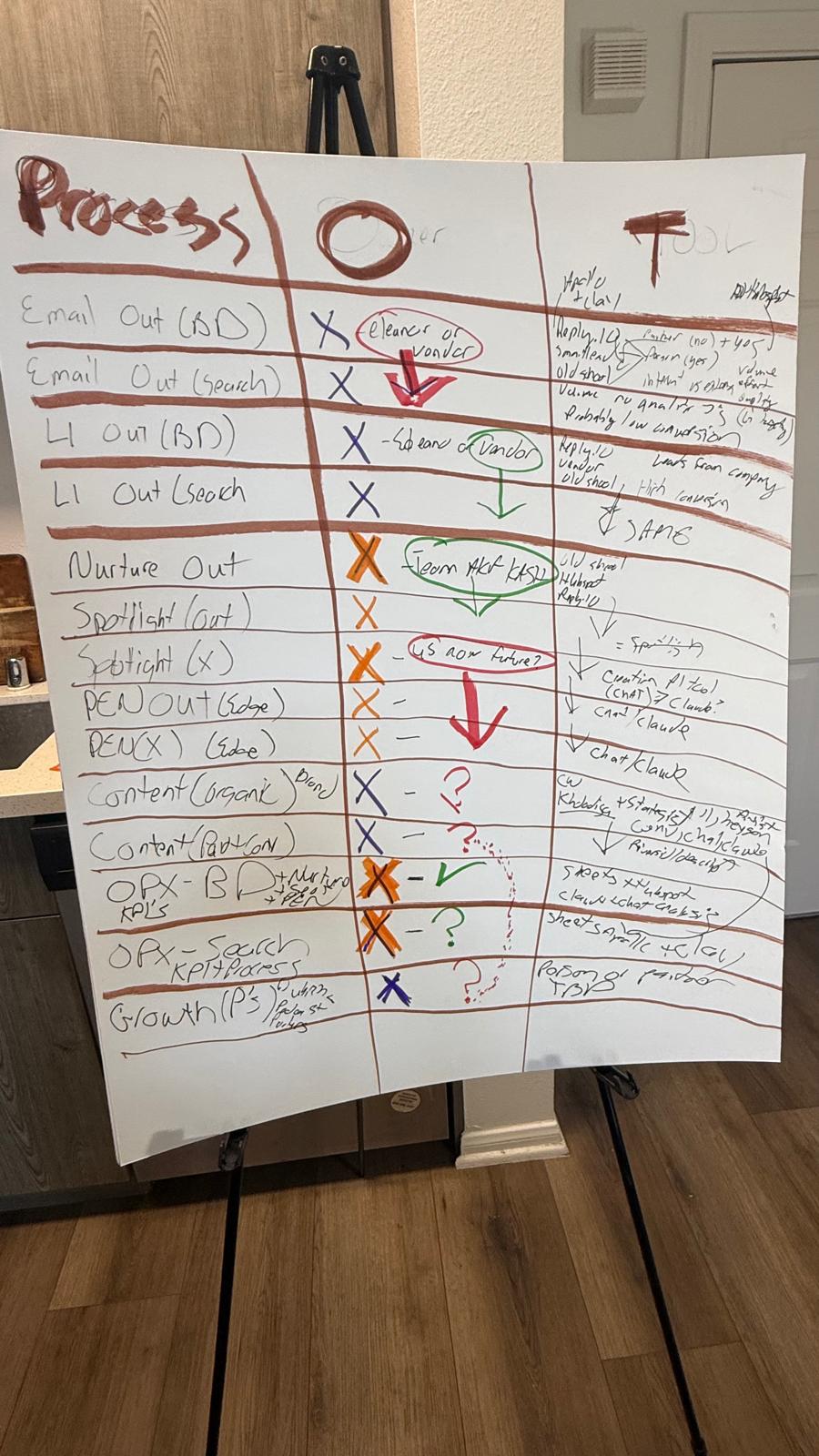
The sheet itself, as sent mid-call. Process · owner · tool. The four outbound rows carry the only "vendor" notes on the page.
Your buyer cannot be rushed into needing a search. They can be guaranteed to think of you first when they do. Everything on this page is that one sentence, industrialized: two written channels, one choreography, concentrated city by city.
Your LinkedIn seat and one for your team, run human-paced and proxied, in copy written to sound like you on a good day. The email opens the door at scale, and inside a day or two the LinkedIn note puts your face on it. Never the same words twice.
You told us plainly: your outreach is not based on intent, because your buyers do not shop. You target a type of person, the executive senior and confident enough to hear "we don't do exclusive" inside their own company and override it, the change agent who turns into a whale. That persona definition is the targeting model, and we load it as-is.
A signal is not intent. It is a dated fact about a person you already chose: your trip through their city, a seat opening, a platform closing, a conference they are speaking at. It tells us when to send and hands the message its opener, which is exactly the play you already run by hand every time you write "hey, I'm in town." Two lanes race inside the same persona universe: a static lane carrying your proven word tracks at a steady pace, and a signal lane hitting the same people when a moment gives the touch a reason. Your map's own note says intent was extra effort. Here the effort is ours, and your universe is finite, which is the real argument: you cannot afford to burn a small list on generic touches, and signals are how the same names stay warm for years without ever feeling like a sequence.
The table of five, conference floors walked with a scored map instead of a lanyard and luck, and a research page with you on film, so the executive who checks you out before replying finds the version of you that closes. The rooms are where SEA wins.
Every play runs in two-week campaign cycles that sharpen with every round, and the four steps below are how a cycle moves.
Two LinkedIn seats live in week one, one of them yours. Founder-led copy with the automation smell stripped out, choreographed behind the email layer so every touch feels like a person, because it is one.
Executives verified to the actual city, never a metro-area tag. Open CFO and COO seats, fresh platform deals, leadership turnover, all resolved to the named decision-maker with a verified direct contact.
Campaigns aimed at each city three to five weeks before you land. Coffees stack, the table of five fills, and conference trips get the full intelligence treatment: every speaker, sponsor, vendor and attendee scored before you fly.
Eight a month, each a permutation of city, title, segment and angle. When a search lands, slots flip from business development to candidate sourcing and back, on an allocation you set monthly.
Every line here is a starting position, not a decision. The kickoff session exists so you can move these numbers before anything is built.
This table is the heart of the engagement, not the whole of it. The signal plays run next to straight-volume campaigns carrying your proven word tracks to the wider universe of executives in your four industries, and the two race each other. Nothing about SEA needs repositioning. Your offer needs to be put in front of the right people, in the right cities, at the right moments, and that is a campaign-count problem. The plays themselves are opening thinking: some ship as written, some change at kickoff, and some never go to market. The data and your instincts decide.
It is also the honest frame for the choice in section 12, which is now two options instead of three. The Engine runs the four vendor rows of your map on one allocation dial: eight campaigns a month, flipped between business development and candidate sourcing as searches sign. The Practice adds what you asked for near the end of the first call: a dedicated delivery track, the same gun pointed at every signed search on its own capacity so the pipeline never pauses to build a slate, send capacity up to 100,000 emails a month, a third LinkedIn seat, plus the rooms, the dinners organized and the conferences mapped before you fly. Whichever you choose, by month three you own a ranked answer to which motion fills your calendar best, and that answer outlives this contract.
Two LinkedIn seats, run human-paced and proxied, one of them yours. The choreography is the one you asked for on the call: the email lands first, and within a day or two a short LinkedIn note follows from you, putting a face to the email they already have. Never the same message on both channels, because your buyer sees that lazy pairing weekly and has learned exactly what it means about the sender's effort.
And because this audience checks before it replies, the click has somewhere to land: the research page. One recorded hour with you becomes a short film and a one-page site that answers the question every prospect is quietly asking, which is whether you are like the recruiters they already ignore. You are not. Right now they have no fast way to find that out. We make it a ninety-second job.
Your travel schedule, because a campaign that lands three to five weeks before you land turns presence into meetings, and it is the one signal your competitors cannot copy. Open executive seats, departures, postings and interim tags that mark a live need with a meter running on it. Sponsor deal flow, platform closings and add-ons that put a date on the next leadership question. Leadership turnover, the new CEO who rebuilds a team in the first two quarters.
How the data actually works, said plainly. A campaign pulls its records at the moment we build it: city lists verified to the actual city rather than a metro-area tag, seats and deals resolved to the named decision-maker with a verified direct contact. The campaign runs, we score it, and the plays that earn it get promoted to a standing pull so they keep feeding themselves. That promotion is a decision we make together off the numbers, usually around week six.
The phone is out because you called it: for CFOs and COOs being cold-called by a search firm, the channel itself is the wrong message. The written channels carry the motion, and the meetings the machine books become the calls, on calendars, where you are at your best.
And HR is never the target, in any campaign, in any city. Your entire model is built on reaching the executive who can approve a premium, an exclusive and a different way of doing this, before the process gets handed to the department most likely to file you alphabetically with everyone else. The one exception you named, the HR leader with a legal or operations background who actually gets it, is a kickoff decision you make deliberately, never a list-building accident.
You wrote "I bet you can." Here is the first pass, run the morning we revised this document, on the three launch cities and the sponsor track, from the tools in section 07. These are raw counts before the human pass that verifies the city, resolves each name to a verified direct contact and applies your four industries. That pass cuts every number here, and what survives is the list.
What a self-serve database cannot do is the next step: each name above gets city-verified, resolved to a direct contact that passes verification, checked against your relationship map and suppressed against clients before it enters a campaign. On the sample we exported today, a verified direct email came back on 9 of the first 15 names. The rest get resolved by hand or dropped, never guessed.
You already have warmed inboxes and LinkedIn seats. Do they transfer? Yes, on one condition: they pass the audit. Week one, every existing domain and inbox goes through the full health check, blacklists, DNS, sending history, reputation, before a single message rides on it. We are very open to using what you have built and very scrutinous about what we put your name behind. Whatever passes gets used, whatever does not gets replaced on our infrastructure, and the included send capacity is guaranteed either way. If you ever want volume beyond it, the additional infrastructure is passed through at cost, not marked up.
The play the whole engagement is shaped around. Three to five weeks before you land in a city, a campaign goes to the CFOs and COOs who are actually based there, in your voice, offering the one thing this audience rarely gets: a peer passing through who wants nothing from them this quarter. The trip creates real, honest urgency with a date on it, the ask is small, and every meeting it books feeds the network that feeds everything else. When the machine proves a city, the next trip gets planned around the machine instead of the other way round.
The one moment in your market where the need is live and the urgency is real: an open CFO or COO seat. A departure announcement, an executive posting, an interim tag on LinkedIn. The buyer is the CEO, the board or the sponsor, the clock is already running, and almost every competitor reaching them right now is a contingency shop sending resumes. A retained peer voice, arriving in that window with a genuinely different model, is the sharpest contrast this document can draw.
SEA's origin story, run as a campaign. A sponsor closes a platform or announces an add-on, and somewhere in the first hundred days the leadership question gets asked: is the team we inherited the team the thesis needs? You have been answering that exact question since a private equity firm founded your practice on it in 2012. The sponsor is also the single best client shape in your book, because one relationship covers a whole portfolio of future seats, and this play is how those relationships start.
The community you asked us to structure, started at the size where it actually works: one table, five seats, one city, timed to your trip. Finance and operations leaders from non-competing companies, no vendors, no agenda past the conversation. You told us people would come, and that what has been missing is the person who organizes it, confirms it and makes it happen while you show up and host. That person is now us. This runs from your profile, in your voice, and it is written fresh every time, because an invitation that smells merged is not an invitation.
The question you asked near the end of the first call, answered: yes, the same gun points at delivery. When a search signs, capacity flips from business development to sourcing. You hand us the spec the way you calibrate it, and we build the universe and run the approach in SEA's voice. Your site says it plainly: the best operators are not looking and would move for the right opportunity. Reaching people who are not looking is, precisely, our entire trade.
On the August 11 call you set the bar and named the trap. The trap: Apollo-grade data is fine for BD and worthless for recruiting, because on a search the specifics are the whole job. The bar: when the list is dialed, search outreach earns responses in the eleven-to-twenty percent range, not two-to-five. So take the search you have live right now as the worked example: a brand manager in New York, six to ten years in, coming out of one of the roughly 300 brands on your list. That list of brands is the universe. We resolve it to the actual people, tenure-checked and title-checked against your CBA spec, verified direct contact for every name, and your if-then qualification rules run as filters before a single message sends. We did not wait for the challenge. The cut below was run on September 9 against that spec, with a proxy list of 78 prestige-beauty domains standing in for your 300. Your list replaces the proxy at kickoff and the count tightens.
| Candidate | Current title | Brand or house | Location |
|---|---|---|---|
| Lauren S. | Senior Brand Manager - Rabanne | Puig | New York, New York |
| Megan B. | Manager, Global Product Marketing | Estée Lauder Brand - Skincare | Estée Lauder | New York City Metropolitan Area |
| Jullia P. | Manager, Brand Activation | L’Oréal Paris Skincare | L’Oréal | New York, New York |
| Natasha M. | Global Brand Marketing Manager | Olaplex | New York City Metropolitan Area |
| Melanie B. | Manager, La Mer Global Brand Marketing | La Mer | New York, New York |
| Clara G. | Global Brand Manager | Marc Jacobs Beauty | New York, New York |
| Brigid M. | Manager, Brand Marketing | Dior | New York City Metropolitan Area |
| Jasmine W. | Brand Marketing Manager | L’Oréal | New York City Metropolitan Area |
| Jazmin T. | Global Brand Manager, New Business and Brand Growth - Fragrance | Coty | New York, New York |
| Emily R. | Manager, La Mer Global Brand Marketing | La Mer | New York, New York |
Full list on request, names and profiles included. Two rows the proxy list let through, a Veuve Clicquot brand manager and a DKNY one, show why the proxy is only a proxy: parent-company domains pull in sister brands. Your 300 replace it and the list tightens. The gap between a 400-million-contact database and this list is the last three steps, and those three steps are the job.
Plus the person who runs them. You have already paid real tuition on solving this with hires, and the lesson was not that the people were wrong. It is that this is a full trade, not a task.
Every tool above sits on our licenses and is run by our team. At the Engine tier you pay $4,500 a month and the stack behind it lists at more than that on its own, before anybody's time.
Proposed start: the working session the week of September 14, soft launch the week of September 28, first Pitbull city window locked to your first trip after that.
The ninety-minute working session: cities sequenced against your travel plans, the four industries and word tracks loaded, the BD-versus-search allocation set. Suppression loaded. Both LinkedIn seats connected and the first notes go out from your profile. Your existing warmed inboxes and domains go through the full health check, and whatever passes gets used; cold domains are ordered and warming for whatever does not.
City-verified executive lists for the first two road cities, seat and deal pulls resolved to named decision-makers. First target lists back to you for review before anything sends. And the one recorded hour: we script it, film it and cut it into the research page every campaign will link to.
All sequences written against your word tracks and background cuts, scored line by line, reviewed with you. Low-volume soft launch on the new domains to prove deliverability before anything scales.
Cold plays at full volume, replies routing to you and your team, the first Pitbull city window locked to a real trip. First two-week cycle scored and the next four campaigns built from what it showed. Weekly strategy call through month one, every other week after.
Needed direct contact with decision-makers across thousands of US school districts, a universe no data vendor sells, with the actual humans buried behind institutional entities. And alongside the sales motion, they needed specialists recruited.
Mapped every administrator from public data, resolved each to a verified direct contact, and ran parallel campaigns off that dataset, including recruiting campaigns through the identical machine. That is your candidate engine, already proven: the same build, the same pipes, pointed at both revenue and delivery.
A saturated mid-market category, a sales team stretched thin, and a need for targeting that cut through noise rather than adding volume to it.
Intent-based outbound triggered on firms hiring specific roles and engaging with specific content, multi-touch across email and LinkedIn. Your seat-with-a-meter play is that exact mechanic: an open executive role as the trigger, reached through the same two channels, choreographed the same way.
Owner-operators who ignore generic email, in a category that traditionally closes on a handshake, where the deal happens when the buyer is ready and not before. A different industry with your exact dynamic.
Signal data identified operators at the moment of expansion, with sends timed to when those buyers were actually reachable. The finding that transfers directly to SEA: in categories that close on relationship, when a message arrives moves reply rates more than what the subject line says. Your three-to-five-weeks-before-the-trip cadence is built on it.
Real credibility in the space but no systematic outbound, and no clarity on which of many possible angles would produce pipeline. Your question wears different clothes: cities, seats, sponsors or dinners first?
40+ campaign types A/B tested weekly across email, LinkedIn and inbound-led targeting, doubling down only on what converted. This is the direct answer to the thing you cannot decide from a standing start: which of the four motions should SEA lead with, in which cities? You do not have to pick in advance. Campaign velocity finds out with data instead of an opinion.
The honest version of this section is short. We are outbound people, and this proposal bills you only for the rows we are damn good at. The rows below matter, two of them matter a lot, and the right way to handle them is the one we agreed on the call: get the engine live, then scope each of these together, deliberately, as its own piece of work with its own price. Nothing here is forgotten. Nothing here is padded into the monthly number either.
Two hundred people who should think of SEA first, on a rotation that stays human. What you described is a weekly queue: out of fifty touches, maybe fifteen get a genuinely individual note, and the rest get the right piece from a library, the Dallas batch gets Dallas, the COOs get the COO case study, twice-a-year meetings and a quarterly personal email underneath it all. That is a CRM build, not an outbound campaign, which is why it prices as its own project. The natural moment is the GoHighLevel move you said you are happy to make: the engine, the library and the triggers get built once, set up properly and handed over, with Kash running the human layer it exists to serve.
You were clear: interested if the examples match the brand in your head, branded the way a house like Nike is branded, the tennis series, the F1 series, LinkedIn for you and SEA, Instagram and Facebook alongside. So the sequence is examples first, commitment second: we bring samples in your lanes, and if they are right, content gets scoped as its own track. Paid stays separate on GoHighLevel, exactly as you framed it.
The Spotlight creation protocol keeps working the way it works today, and turning it into a tool is a small, well-defined project whenever it stops being low priority. The growth IPs, the book, the podcast circuit, are by your own read mostly email campaigns when their moment comes, and the engine in this proposal already knows how to run an email campaign.
If the engagement has not returned its cost by the end of month four, we run month five entirely at our cost, full effort, nothing held back, and we will connect you with people we have run that month for so you can hear how it went. And at month four you choose: keep going, or take the campaign matrix, the copy, the signal pulls and the research page and run it yourself. They are yours either way.
Claim your guarantee →The ninety-minute working session. We sequence the cities against your actual travel plans, load the four industries and word tracks, set the BD-versus-search allocation and write the meeting definition. It ends with a target list on screen, not with a follow-up email.
Your LinkedIn seat goes live in the first few days, in your voice, sounding nothing like automation. In parallel, domains warm, the city and signal pulls get built, the research page gets filmed, and suppression loads. You review every target list before a single message sends.
Cold plays live around week four at full volume, timed to your first city window. Every two weeks a fresh cycle of campaigns ships, built from what the last cycle showed. Weekly call through month one, every other week after. At month four, you choose what happens next.
Your note said one way or the other. This is the way in: choose the tier, sign, and the kickoff session gets booked for the week of September 14.
Four campaigns every two weeks, eight a month, across the four vendor rows of your map: email and LinkedIn, BD and search, one allocation dial.
Both sides of your map on one machine. The engine brings the clients in, a dedicated delivery track builds the slate for every search you sign, and the rooms are handled for you.
| Onboarding & infrastructure setup | One-off | $1,000 |
| Total recurring |
Client: (fills from your signature) · Contact: (fills from your signature) · E-mail: (fills from your signature)
Selected Package: · Service Fees: , payable in advance per Section 7 · Billing Option: · Amount Due at Acceptance:
Onboarding Fee: , one time · Initial Service Term: months from kickoff, followed by month-to-month. Address and phone are captured on the onboarding form.
Services: Charm is a Go-To-Market Business Process Outsourcer (GTM BPO) providing Strategic Executives Agency sales expertise and lead generation services per the selected package: lead acquisition against ICP criteria agreed at kickoff, systems and infrastructure setup, and campaign development with ongoing strategic support.
This Master Services Agreement ("Agreement") is entered into as of the acceptance date recorded on this page (the "Effective Date"), by and between Charm, registered as Didin Customer Service, LLC ("Charm"), located at 1220 E. Henry St, Tempe, Arizona 85281, and the client identified on the Order Form above ("Client").
Charm provides an AI-powered lead generation system with outbound efforts via email and LinkedIn campaigns promoting Client's goods and services for the purpose of generating and nurturing leads for Client (each, a "Campaign"). "Lead" means a potential customer contacted through LinkedIn or email for the purpose of Client offering its goods or services. Charm performs the services in a timely and workmanlike manner. Scope changes require written agreement before work begins, and Charm may charge reasonable costs associated with such changes.
Charm has full power and authority to enter this Agreement; performing it violates no other contract; lead sources infringe no third-party rights and promote no prohibited content; and performance complies with applicable law.
Client has full power and authority to enter this Agreement; performing it violates no other contract; and contact data Client furnishes has been diligently verified as serviceable and current.
All creative campaign assets are created by Charm. Charm may request existing content from Client to leverage in Campaigns. Client grants Charm a limited, non-exclusive, revocable, royalty-free license to use Client's marks solely to perform the services, ending with the Campaign or this Agreement. Client retains all rights in its intellectual property.
Before launch, Charm sends test materials for review. Client has a 24-hour window to object; silence is approval. Client may review each email before every new send, with the same 24-hour window.
The engagement runs an initial term stated on the Order Form (the "Initial Term"), then month-to-month. Fees for the Initial Term are committed at acceptance; neither Party may terminate for convenience during it. Either Party may terminate for material breach uncured within fifteen days of written notice. After the Initial Term, either Party may terminate on thirty days written notice. On termination, Client pays fees accrued through the effective date; if Client terminates for Charm's uncured material breach, prepaid fees for whole unstarted months are refunded.
All fees are payable in advance. The onboarding fee and first monthly period (or the discounted Initial Term fee, where paid-in-full is selected) are due at acceptance and presented for payment on this page through QuickBooks. Client authorizes Charm and Intuit QuickBooks Payments to store the designated payment method and charge it on each monthly anniversary of kickoff, invoice delivered seven days prior. Card and bank details are held by Intuit, never by this page. Paid-in-full reflects the discount stated on the Order Form; the onboarding fee is not discounted. Late amounts incur 1.5 percent per fourteen days past due, and the program pauses seven days after written notice of nonpayment.
Charm retains access to Client data to perform the services. Client may view and export all Campaign data at its discretion.
Each Party protects the other's Confidential Information with at least commercially reasonable care, uses it only to perform this Agreement, and limits disclosure to those under equivalent obligations. Standard exclusions apply (public information, prior knowledge, independent development, rightful third-party receipt, Campaign materials and metrics). Trade secrets are held indefinitely; other Confidential Information for five years. Legally compelled disclosure requires reasonable prior notice.
Charm shall not use Leads provided by Client for the benefit of competing ventures, during the term and for one year after.
Each Party indemnifies the other against losses, including reasonable attorneys' fees, arising from its breach of this Agreement.
Arizona law governs; exclusive jurisdiction lies in Arizona courts.
Invalid provisions do not void the remainder; the Parties negotiate replacements in good faith preserving original intent.
No assignment without written consent, except to a merger successor, asset purchaser, or commonly controlled entity.
Charm performs as an independent contractor. No partnership, joint venture, agency, or employment is created.
Both Parties comply with all applicable Do Not Call and Do Not Contact regulations, maintain lists against registries, honor DNC requests promptly, and keep required records.
No waiver except in signed writing. Remedies here are in addition to those at law or equity.
Acceptance through this page, together with the typed name and the recorded SHA-256 hash of the Order Form and this Agreement as displayed, constitutes a binding electronic signature under the U.S. ESIGN Act and UETA. Charm: Didin Customer Service, LLC, by Chris Booth, Owner.
Ten minutes. Brand voice, ICP, suppression, access.
2 · Book your kickoff →The onboarding discovery session.
Arrives with your kickoff confirmation.
Pick a kickoff date. Week one is the parameter session, the cities sequenced against your travel, your word tracks loaded, and your own profile live in your voice. None of that waits on infrastructure to warm, and the next Pitbull city is three to five weeks out from the day we start.
Pick your kickoff date →